Thursday, February 16, 2012

Cod Portocaliu

Bucharest, and all of Romania, got hit with a hard winter so far this year.  It all started in late January with snow blanketing the city.  There was so much snow actually, that all US Embassy and Peace Corps employees had a day and a half off while in some Romanian counties students had the better half of the week off... “SNOW DAY”!  It didn’t stop there.  The first storm of pretty steady snowfall lasted three or four days and was followed by georgeus days if you’re seeing them from a warm place with a hot cocoa.  The sun was shining bright and the air could freeze your lungs.  That period was followed by another two or three days of snow, and another period of nice, then the last major snow came again at the beginning of this week.  The weather ahead looks sunny for quite a few days and people are beginning to recover from the storms.  

If you’re reading this and you’re not Romanian then you are probably wondering what “Cod Portocaliu”, the title of this post means.  In Romania, and I believe throughout all of Europe, there is a color code describing the severity of weather conditions and "Cod Portocaliu" meands "Code Orange" in English.  Its kind of like the terror threat scale in the US.  News flashes of the Secretary of the Department of Homeland Security would flash across the screen and you would hear the anchorman/woman spouting code yellow or code orange meaning that we should all be oneshade darker frightened.  The Terror Threat (TT)advisory code (which was phased out in 2011) is actually very similar to the weather advisory code in Romania.  Today is code green and no one seems to know or care.  Code green is not spouted over the news because code green means that you don’t have to be alert for any weather-related hardships today.  Code green is also the TT level that you never really heard of because it actually meant that there is no threat.  In the TT code there is also a blue (guarded) but after blue the threats follow the same succession as the weather threats in Romania, yellow (watch out), orange (you’re already buried in snow), red (I don’t want to know).  

My personal experience through a good chunk of the 2012 snow extravaganza of Bucharest took place in my small studio apartment as I was sick for all of last week.  Luckily, before getting sick I had the chance to get out and to “dau cu punga”.  “Dau cu punga” translates word for word to “give with a bag” and while all you language learners out there know that you usually can’t translate word for word you can probably figure  this one out by the context; sled riding with a plastic bag instead of a sled. Now, if you have ever been to Bucharest you may be a bit confused.  Many fellow volunteers have asked me “You can sled ride in Bucharest, isn’t it flat there?”.  Well Buc is pretty flat but there is a perfect sled riding hill in Parcul Tineretului, large enough and steep enough to catch some speed but still easy to climb up, allowing the maximum number of quality runs in an evening.  

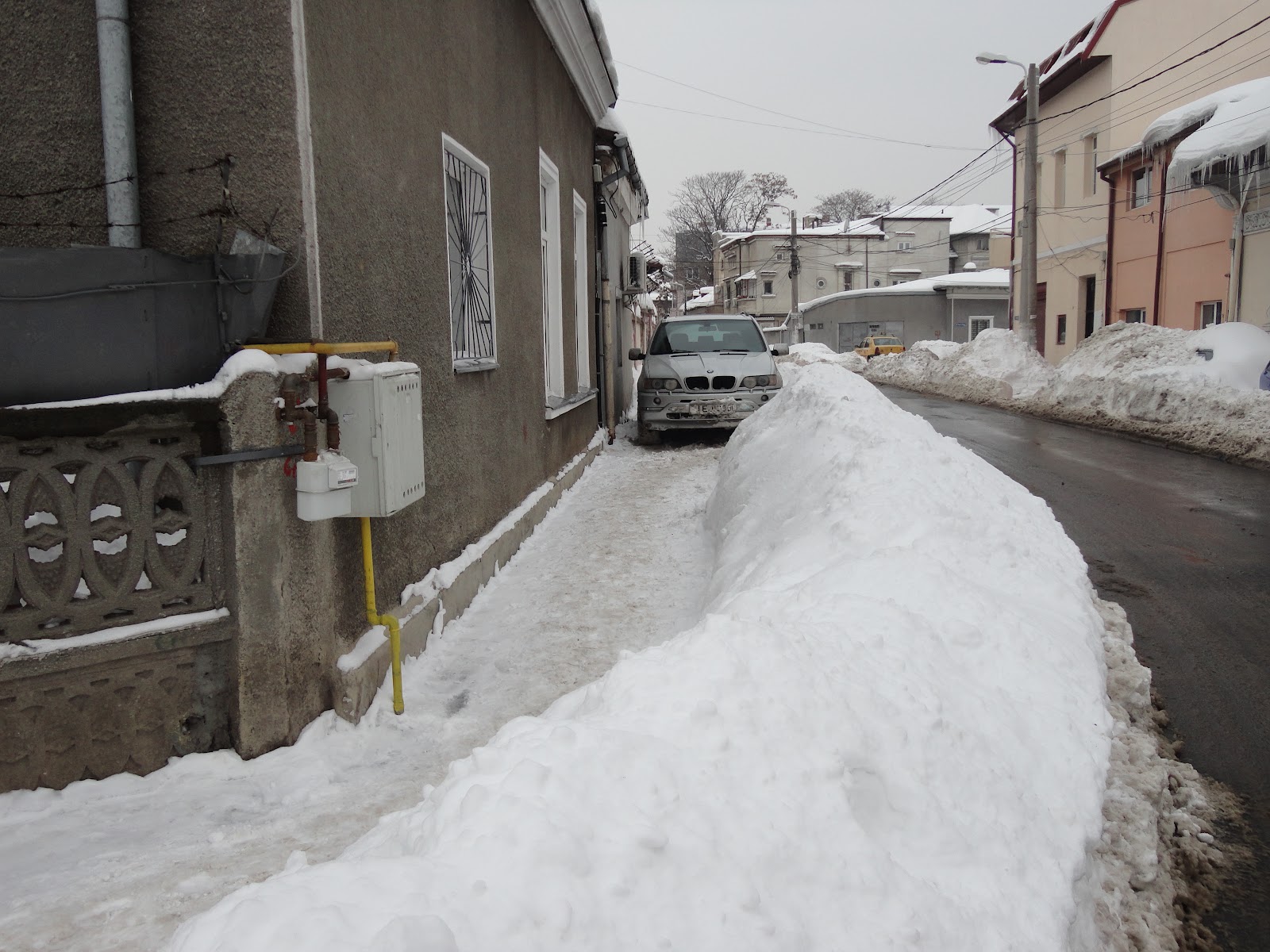
Now that my cold has passed I have gotten a chance to get out in the city, walk to work, and view the destruction.  The main streets are in good shape for cars but walking is a workout regardless of how far you have to go.  Some sidewalks are clean but most are not and walking means trudging through soft wet snow.  Its a similar feeling to walking through sand and personally I prefer running through it.  Its on the smaller streets that the negative effects of the snowfall resist.  By this time, a few days after the last snowfall, there are paths or some clean sidewalks on the side, but in classic Bucharest style usually you’ll find a car parked on the sidewalk forcing you to walk in the road.  This is where it gets tricky.  On the small streets, the normally narrow two lane road becomes a one lane road after a snow storm.  Even though its a one lane road many people still use it as a two way road and you often see two stubborn drivers facing each other honking there horns refusing to give way.  If one driver decides to let the other driver pass how does that driver do so?  They either must back all the way up to the last intersection they crossed or risk getting stuck trying to turn around.  Lets say you’re forced to walk in this area where the cars go.  You must walk in the middle of the road through snow that once again, give you the feeling that you are walking through sand.  Its enticing to walk through the car tracks where the snow isn’t as deep but if you dare put two feet down in that area then you are falling.  The tracks consist of a thin layer of snow covering several inches of thick uneven ice.  I’ve gone down twice so far, once in then middle of an intersection.  

Day one of walking to the Peace Corps office this week I took a new, beautiful route to mix things up.  Along my route I saw many picture worthy moments of buried cars, cars on sidewalks, nice winter city scenes.  I also ended up helping to push three cars that got stuck on the small streets.  Day two of walking to the PC office I decided to bring my camera and here are some of the shots.  


Happy Valentine's Day


The frustrated walker
Piata Alba Iulia


Saturday, February 11, 2012

Podcasting course

When in Romania I'm continuing to learn new things.  Over the past five weeks I have been periodically tuning into an online course that I decided to join.  My program manager at Peace Corps found out about it somewhere and sent out a mass email to all PCRo volunteers about it.  I happened to be the only one of us that decided to sign up and it ended up being a pretty good decision.

The course was entitled "Podcasting for the ESL-EFL classroom" and though our moderators were based in Venezuela, participants tuned in from all over the world.  The course covered the basics of podcasting from the free audio-editing software to the publishing online.  The course also covered useful ways to use the podcasting in an ESL-EFL classroom.  Participants had to draw up a project outline that they can use in a classroom setting.  That is, a hooked up classroom setting with computers, headphones, internet and freedom to download the necessary software.  Finally the participants had to present all of there work on a blog that they themselves designed with the guidance of the moderators. 

Below is a list of the tools we used and learned about:

yahoogroups
WIZIQ
Glogster
Podbean
Podomatic
Audacity
Blogger
Free Music Archive
Audioboo
Vocaroo
Chirbit
Pixlr
VoiceThread
Virtual Presents

and many more mentioned in the required readings. 

Many of these tools offer great ways to integrate technology into the classroom. 

My final product is a blog named AndyCasting which includes all of the podcasts that I recorded for the session as well as the project that I came up with. Click here to check it out.

Friday, January 27, 2012

NYE- Krakow


In classic New Years Eve fashion I found myself in yet another new place.  My past five New Years Eve celebrations have popped off in classic all-night party fashion, all in different parts of the world.  The latest of the five celebrations rang in the year 2012 in a country that, until this past summer, I never really saw myself visiting.  It ended up being a great decision with all the fun and interesting travel experiences included. 

Krakow, Poland is pretty interesting old city.  At one time it was the capital of Poland but it is now better known in as their beautiful old medieval city; a place you want to go if you’re into the history and want to see the sights.  Little did I know before taking the old town tour, it is also pretty well known throughout Europe for its particularly rowdy soccer fans as the city includes two rivalry teams.  So rowdy I’m told, that Poland decided to exclude Krakow from hosting any Euro 2012 matches.  The clean, pristine old town with the Wowel castle at its head looking out over the Visla River is surrounded by a band of parks.  Crossing that band will take you out of the medieval city and onto streets lined with 18th century buildings including some traces communist architecture popping its head out from time to time.  Certainly walking the old town is a pleasurable experience with its churches, large square, and small intimate store fronts, but even outside of the old town roaming can be a pleasurable experience.  

Welcome to the Goodbye Lenin!
The New Years Eve celebration was in itself a pretty great time.  The first face I saw when entering the hostel was that of my brother Nate.  Just before entering I figured that he had probably showed up and left the hostel already, getting out on the town to see what the next few nights have in store, but to my surprise I caught him just before going out to pick up some beers so I had him pick up a couple for me.  The Goodbye Lenin Hostel rocked from the people working there to its convenient location next to the Jewish quarter.  Peace Corps Ukraine represented about half of the guests at the hostel.  That is a slight exaggeration but there was a very large group of volunteers from Ukraine present for the NYE celebration.  I was lucky to have had the chance to meet, hangout, and have extended chats with many of them.  Once again I’ve realized that the really great times that you have when traveling happen when you’re around like-minded people, open to new experiences.  You’re all just having a good time. 

A trip to Krakow isn’t complete without getting out of the city for one of those days and checking out Auschwitz.  A good part of the 2nd of January was spent bussing it to the camp and roaming around the grounds with a tour guide.  There’s an informative museum at Auschwitz I with some pretty intense displays and the sheer size of Auschwitz II was imposing.  Images from Schindler List flashed through my head. 

The following day was Nate’s last day in the Krack.  We spent the day seeing more of the city including the National Museum where we pretended to be WWII soldiers and an English book store where I finally acquired some reading material for the trip (I had left my apartment to travel alone to Krakow without a book!).  I had decided to stay in Krakow until the 5th instead of heading right back to Warsaw.  After seeing Nate off at the bus station on the 3rd I had a couple more days of roaming around on my own seeing more of Krakow and then a bit of Warsaw.  

It poured those last couple of days dampening the mood that was already dampened when Nate and the rest of the PCU volunteers left to go back to their sites.  Every time this happens; the first couple of days following a nice long get-together you feel more alone than you’ve ever felt.  Even though it rained, I took the chance to put a good sized dent in the rather large book I had just purchased (The Shock Doctrine-Naomi Klein, you should read it if you haven’t already) while enjoying coffees or food in small cafés.  I also took the time to go through the museum of Nazi Occupation in Krakow which was located in Schindler’s factory.  While walking through that museum I realized that in the 2.5 years I’ve been in Europe I have only been to a few museums.  The 5th was a long day of walking around the amazingly rebuilt old town of Warsaw to conclude my Polish NYE adventure.  

UNESCO Site, the Old Town Square in Warsaw rebuilt after being destroyed by the Nazis at the end of WWII
After three NYE celebrations, in three different European countries I’ve realized that they’ve all followed a pattern.  Each time I have seen new places, met new people, hung out with good friends, enjoyed the travel, but all centered around a big, all-night party.  On our tour through the old town I actually chatted with some people who recognized me from the hostel in Budapest for last year’s NYE celebration.  Not bad, the only question is, where to ring in the year 2013?

Tuesday, December 27, 2011

Christmas Eve

To celebrate Christmas this year I decided to prepare some traditional Romanian food, salata de boeuf and sarmale.  While chopping vegetables on Christmas eve I heard some loud noises coming from the street behind my block.  I quickly grabbed my camera and headed to my balcony to film the scene below.

Part 1:


Part 2:


Merry Christmas!

Ignat


            It’s that time of the year again.  The city is lit up, the nighttime air is spiced with cinnamon and cloves as the steam rises out of the warm glasses of wine, venders all around town are pushing goods of all shapes and sizes into the faces of eager consumers, and in the thousands of small villages peppering the countryside of Romania, pigs are dying.  “Ignat” takes place on the 20th of December.  The word “Ignat” is actually the Romanian version of the name Ignatius and like most things Romanian, the 20th of December has religious significance.  Even though the 20th is the feast day of Saint Ignatius of Antioch the word is synonymous with the annual pig slaughter because of its convenient timing, 5 days before Christmas.  There’s just enough timing in between Ignat and Christmas to get the meat checked and ready to feast on after the long Christmas fast.  Due to the busy week schedule, the onrush of capitalism and the slow fading of tradition, the annual event of “Ignat” no longer actually takes place on the feast day of Ignatius, unless of course that day falls on the weekend.  This past weekend was the weekend before Ignat, and even though blood was spilled the courtyards of many country homes, good food and drink were offered in remembrance of the pig freshly slaughtered.

            It was about 9:30am on a Sunday morning in a small Romanian village that bears the name “Valley of the Monks” when three PCVs stumbled into Nico’s courtyard awaiting the feast day’s events.  The PCV’s were late and they had missed the actual killing of the pig.  They halted shortly after entering the gate with eyes fixed upon the scene.  There was an older man and a younger man each with torches in one hand and a knife in the other, burn scrape, burn scrape.  Despite their seemingly carelessness of where they set down their torches, it was clear that this wasn’t their first hot dance.  They were pros, and this was just one of their many pig slaughters of the season.  Soon after arriving, our host, busy with preparations of sorts, came out of the house with a large welcoming smile across his face.  In one hand he was holding a steaming pot and in the other he had a large tray with mugs.  After clearing off a spot on the nearby table he began to pour the not so clear liquid into the mugs and handed them out.  A morning cheers quickly followed and then we drank.  It had been two years since I had tasted tuica fierta and I had forgotten how much I had actually liked it.  My last taste of the drink took place at the same time of the year, while watching another pro clean a recently butchered pig, several hundred kilometers to the west.  Meanwhile, looking around the group I noticed that the one of the men working on the pig put his scraper down for his glass of tuica.  Tuica in one hand and a torch in the other, drink, burn, drink burn. 

Grandma cleaning out the intestines.

            After burning the hair off and cleaning and salting its skin, the men methodically began taking the pig apart starting with the head.  The first cut was the traditional cross cut in the head of the pig, reminding those present that they are thankful to God for the large healthy pig on the table.  The pig started as a 200+ kg mass on a table and in about a half hour all that was left on the table was one last flat slab of flesh.  I watched them pull the different parts of the pig off while standing next to my friend Jeremy who has a passion for food.  As they pulled off each part he explained what it was and what it is used for in the culinary world.  For him, knowing his way around food, it was obvious that seeing the slaughter was an interesting experience.  Meanwhile my other friend Aron was carefully documenting the activity by taking pictures, and our host Nico was lending a helpful hand to the professionals cutting the pig.  After all, it was all his meat.  Aside from the group, we were accompanied by some entertaining animals.  Between watching the butchers and chatting with Jeremy I was noticing the cats roaming around the scene slopping blood up off of the cold concrete.  Despite how domesticated an animal can be there are still instincts that kick in.


Pomana porcului was the culmination of the day’s activities.  Pomana porcului is the meal that the host offers those present who helped out with the slaughter.  Even though we didn’t help out very much we were guests and therefore we became direct beneficiaries of the delicious food served.  The meal consisted of some of the meat taken from the pig recently killed fried in fat from the pig.  There was also mamaliga, tuica and wine served, all products produced by the host.  Despite the cold, the meal was served at a table in the courtyard.  After enjoying the meal we continued to sit and enjoy the day and our great host Nico who brought out a pair gloves that he used to box with.  Back in the day Nico was one of Romania’s star boxers.  

For me, the event acted as a reminder of the beauty of the countryside.  After spending so much time in the city sometimes I forget how much I enjoy the fresh air, traditions, and hospitality that can be found not far beyond the limits of the city.  In some cases these traditions can also be found within city limits.  I remember walking to school on a cold morning before the winter break began last year and seeing torches lit in between city blocks at my old site.  Even though last weekend may have marked my final pomana porcului, it will not be the last time I make the trip to spend the day in the beautiful Romanian countryside.  In so many places in Romania the beauty of the countryside means incredible mountain scenery, rivers and lakes, but in so many more places in Romania the beauty of the countryside means much more than that.  It is the tradition, stories, and hospitality of the people who reside there.  

 Romania, te iubesc! 


Friday, December 16, 2011

Planting Season


 Planting season has come and gone!  Over the past several weeks I have been assisting in the planning and implementation of the fall series of tree planting projects that my host country organization puts on each year.  Before the tree plantings started, my host country organization MaiMultVerde (MMV) organized a course to train volunteer coordinators in planting projects.  The course gave its 40 participants the skills needed to plan and implement a tree planting on their own.  It also expanded the pool of coordinators that MMV utilizes to assist in their own plantings.  The planting projects offered by MMV give those coordinators some practical experience in conducting a tree planting activity.  The season started with a bang.  

Three tree plantings were scheduled for the last weekend of October.  There was a small one in Bucharest on Friday, a larger one in Ploiesti on Saturday, and the largest was held on Saturday in a small village called Lesmir in Bihor County.  

Panorama from the top of the hill at the planting in Lesmir
The Lesmir planting was set up on a bare hillside for the purpose of helping to prevent future landslides.  The MMV team along with the coordinators made the 10-12 hour trip by van to Marghita where they stayed and commuted to Lesmir.  It was a beautiful area of Romania, but as you looked out from atop the steep hill where the planting was to take place, you saw a number of towers in the distance poking up out of the foggy haze which had settled in the valley.  We were in oil country.  Those towers were oil drills and our tree planting activity was one of the many projects funded by “Tara lui Andrei” the CSR branch of Romania’s largest oil company, Petrom.  On Friday the Petrom coordinators set up the location to receive volunteers while the MMV team and coordinators set up the planting area so that when the volunteers arrived the next day it would be easy for them to know where and how to plant the “puieti” (young trees).  The hard work setting up the terrain and early morning wake-up time the following morning, put the MMV team and coordinators to bed at a decent hour, eagerly awaiting the next day’s events.  

The team was up and out the door into the cold morning by 6:30am.  The sun had not yet risen and the sharp sting of the cold northern air was enough to wake up each member of the team as they all piled into the vans.  The warm air circulating through the vans discouraged them from exiting once at the planting site.  Minor morning preparations had to be made in order to be ready for the four hundred volunteers who were about to show up ready to work.  The volunteers consisted of children from the local schools with their teachers, nearby community leaders, and Petrom employees with their families.  They were split into four teams with two of MMV’s coordinators helping each team.  As with all of the season’s plantings, the first several minutes are the most hectic and crucial.  Volunteers come ready to start and tend to rush into things rather than patiently and attentively listening to directions.  In the first half hour of planting the coordinators must make sure that the volunteers are doing it correctly and in an organized fashion.  After that first hour things seem to go rather smoothly.  

Unfortunately, for the coordinators of the two blue teams, things didn’t go so swimmingly that day.  The day before, we identified one of the yellow sections to be the most difficult because if it’s steep grade and tricky terrain, but the blue section ended up being by far the most difficult because of its hard soil.  The soil in the yellow teams’ section was much more sandy and easy to dig, but the soil in the blue teams’ section was difficult to break and volunteers lost their patients.  After giving some instruction, handing out some water, and getting dirty a bit, the blue team coordinators got through the lengthened first half of the day which ended in an awards ceremony for the hard working volunteers.  The second half of the day consisted of cleaning up the planting terrain after the volunteers left and then heading down to the small village of Lesmir to eat and drink with the locals.  Certainly that evening the volunteers and some of the coordinators continued celebrating back at the old hotel in their host city of Marghita.  The next day came early but much less taxing as the group only had to pile back into the vans to embark on another 12 our trip back to the capital.  

The Lesmir trip was only the start of the planting season and it created a team that would come back together as a whole for the final planting in Marsani.  Many of the Lesmir coordinators were involved in the plantings in between the first and the last as well.  All in all, MMV organized seven tree planting activities in the fall of 2011 addressing one of their goals of the reforesting Romania.  At the final and largest planting of the season an impressive 37,000+ trees were planted in an area that you could play beach volleyball on.  We were not planting in soil, it was sand.  Riding the bus away from the planting site you could see large plots of trees planted in the same ground a few years earlier taking nicely to the soil.  Plus, the trees planted were one of my favorites found in Romania, the acacia tree.  Seeing the before and after, and the realization that a forest was just planted was a very rewarding aspect of the project, but certainly not the most rewarding aspect.  Meeting, working with, and getting to know the coordinators was by far the most valuable reward that I gained in this project.  For that I thank MaiMultVerde.  For the coordinators themselves, maybe it was the trees and realizing the positive impact that they can make, maybe it was the smiling faces and the interesting stories of the volunteers they coordinated, or maybe it was getting to know the other coordinators a bit better.  If one of the coordinators happens to read this I kindly ask them to leave their perspectives in the comment section below.  

If you wish to donate to future tree plantings you can donate here.  Ten RON ($3) plants 1 small tree. 

Tuesday, November 22, 2011

Capturing Fall


The above video was prodused by Totoran Bogdan, a student in the the school where I worked in Petrosani, Colegiul Tehnic "Dimitrie Leonida".  The pictures used in the film were taken by a former colleague and great friend Ioan Ilea Ernest. 

It used to be done by raking leaves into a big pile next to a tree, climbing up in the tree, letting yourself go and enjoying that feeling of being in a cloud.  Evidently we grow and that pile will no longer support our weight but we still manage to capture the magnificence of fall.  Whether it be the bright colors popping out in the landscape, the crumbling of leaves under your feet (or rake), the taste in the air when the first cold separates the seasons, or one of the early games of the highly anticipated football season, fall is a season highly anticipated by many and at times seems all too short. 

The Romanian fall of 2011 came like a slap in the face.  Rain had totally held off in the two months leading up to the abrupt changing of the seasons, making a difficult living for the buretar (mushroom picker).  Suddenly the weather changed from t-shirt to hoodie and beanie, and a couple days later clouds rolled and the rain began to fall.  Unfortunately for the runners of Bucharest, the Bucharest International Marathon was scheduled for that first day of cold rain.  Despite the gloomy weather I had to leave the apartment early that morning to catch the start of the race as it took place in the closest square, a two minute walk away.  Seeing the runners warming up in their spandex get-ups and their skimpy shorts took me back to that one year, in eighth grade, when I captured the fall by running cross-country.  The air in Bucharest had the same bite to it, the same taste as those cross-country meets.  I remembered the warm-up exercises, the black Lifa beanie handed down from my older brother, and the skimpy shorts that we had to wear.  Since those first few days of the 2011 fall I’ve been taking any chance that I can to appreciate the season, knowing that the leaves fall in the blink of an eye and that a cold, dark, but beautiful winter will soon descend on Romania. 

In the past three years capturing fall for me has taken place through a camera lens.  I’m no pro at taking pictures but I like to do it and it gives me one more excuse to get out and appreciate my surroundings regardless of the season.  I was recently looking through the only pictures that were ever on my ipod, which consisted of pictures taken during my last fall in the states.  They include some pretty rockin Halloween pictures of Jay and Silent Bob but also some fall shots of the finger-lakes region of New York.  The colors on the surrounding hills created a scene that I thought I might have to give up for a couple of years while I’m abroad.  It turns out that those beautiful fall colors were very present and even more vibrant in the region of Romania where I was placed.  Walking through the Jiet Canyon or the Jiu Gorge the bright colors of fall surround you on all sides and at times seem to cover you.  The best time to take shots is when you see those great colors with the perfect blue background of the sky on a clear sunny day.  As that cool wind blows by your cheek you’re reminded of the beauty in the changing of the seasons, a feeling that can’t be captured by even the greatest camera lenses. 

Living in the big city now, I knew that I would experience a different kind of fall season.  Rather than beautiful rolling hills surrounding me every day, I have concrete blocks, streets, cars, and too many people to appreciate.  Luckily for me I live in a pretty green city.  There are still trees in between the blocks, beautiful parks, nice architecture and opportunities to get out and see the countryside.  For a couple nice sunny weeks October and November the wind would blow leaves into my path while riding my bike to work in the morning.  The major highlight of this fall was having the opportunity to join a dedicated group of environmental volunteers in planting more trees so that future generations can experience the joys that I have experienced in the past and will continue to experience in years to come.