Showing posts with label Balkans. Show all posts

Wednesday, June 27, 2012

Kotor

Descending from the clouds at a forty-five degree angle, first white rock, then green grasses until the landmass, one of the many ridges, disappeared into the gray waters of the Bay of Kotor.  Following the closest ridge up from small city uncommon structures appear in the hillside.  Uncommon only in shape next to the craggy rock landscape, the first church appears up on the mountain.  Yes that's right, a church, "we're in Christian country" I thought, when aren't we in Christian country. 

First built by the Romans and later governed by Serbia, the Republic of Ragusa and Venice the small medieval city is now a part of one of the newest countries of Europe, Montenegro.  The language once spoken in this hidden town on the Adriatic coast was Dalmatian, the romance language that at one point most closely resembled Romanian but now it is a dead language.  Nowadays you hear mostly Serbian echoing through the narrow streets but English, Italian and German are also common tones.  The Vrmac tunnel completed in 2007 gave the town access to the Adriatic coastal route making it easy to ship foreigners in by bus, at least the ones that can't afford the Adriatic cruise liner.  Despite the easier access, Kotor is a breath of fresh air next to Dubrovnik.  Tour groups stroll the streets in the morning but on a May evening the terasas are filled with empty seats, giving the wandering backpacker a romantic sense that they found the gem they had been looking for after much time on the road.

Years ago I saw a poster on a wall with an image of a place where the mountains met the sea.  The picture could have been taken in one of many locations throughout the world and though that particular place isn't something that stuck so well in my mind, the idea of it did and it became a dream of mine.  If given the choice between the mountains or the sea I would choose the mountains, but knowing that there are places where both wonders exist and mesh together so well I decided that someday I would be there, at least to see it.  Kotor was that place where I could both see and enjoy it.

Rising high above the barely coastal town is Lovcen, a national park of high mountain peaks where the poet and national hero Njegos peacefully rests.  A full day of hiking will probably get you to his burial place and back to Kotor before nightfall during peak summer hours.  The nicely, beaten down shepherd road will take you through a series of switchbacks rising quickly out of town until you reach a forest partly shielding you from the beating sun or unexpected storm.  Another hour of climbing and you arrive at the road winding along the mountainside as it connects the bay with the old capital city several kilometers inland.  The hike is intense and physically straining but you're reminded of its value each time you stop and take a look around you.

The bay is full of wonders from the steps of the fortress walls high above the city of Kotor to the steps of the island church Gospa od Skrpjela (Our Lady of the Rock).  Its an artificial island off the coast of the small fishing village of Perast.  They say that there used to be an annual tradition in the village to row out to a certain point in the bay and through a rock in.  Eventually the rocks piled up to make a small island where the church now stands.  Though the islands are the main attraction, an easy stroll through town is the unforeseen wonder of Perast.  Small boats line the water's edge with old stone buildings situated across the only drivable street in town.  Locals struggle to keep there boats from violently crashing against the concrete walkway after a cruise-ship out in the bay slowly crawls along trying to find its narrow exit.  The tiny town is starting to see some of the effects of tourism, both positive and negative. 

Its those places that you never heard of or thought of going that hold some of the greatest secrets.  I'm sure that the Bay of Kotor holds many secrets and three days is hardly enough time to uncover them.  Kotor itself appears to be a secret just recently uncovered.  Looking at Kotor from high above the bay you can see that it is tucked away in the bay's most secluded corner, hidden from the vastness of the sea.  After visiting such a quiet old city you're glad that the secret was uncovered just enough for you to discover it but hope that word doesn't reach the masses.  I didn't see a single highrise there, and I hope I never do. 

Perast and the two islands in the bay, the Island of St. George and Our Lady of the Rock

A walk through the village of Perast

The switchback leading up the mountain and out of Kotor

The view looking down on the bay
A small church on they way up to the fortress above Kotor


Wednesday, April 27, 2011

Walkin' in the Balkans

With some annual leave days left and the end of service nearing, an out-of-country excursion made perfect sense for the long Easter week off this year. Romania is the place to be for Easter celebrations so we had to be back in country by Holy Thursday. A six-day leave was in session starting on Friday with our early morning train departing from Timisoara into Serbia and ending with a leisurely walk across the border back into Romania the following Thursday.

Yes, I know that after my last venture into Serbia I swore never to return. I lied. Since the last trip there for NYE 2009 my curiosity in the region has been growing. My wonderful experiences in Turkey have helped to peak my interest in Sarajevo, another city where east meets west. Serbia was the necessary stopping point on the way to and from Sarajevo, and under much more ideal conditions my visit to the country that US and NATO planes bombed in the semi-recent past ended up shedding a positive light on the country. Successfully finding our hostel is just one of a few more positive conditions this time around.

Less than ideal was the transportation situation. Train connections left my travel buddy and me sitting in a gas station for hours missing some much needed sleep before even leaving Romania. If one was to look at the distance from Belgrade to Sarajevo on a map they would certainly not say that it takes 10 hours to get from one to the other by train. Unfortunately that is what the man selling the tickets says as you're handing over your money. At least it didn't cost much. Though a collective 20 hours of daylight lost in transportation leaves a sour taste in the mouth of just about any traveler, it didn't seem all that bad. The compartments were surprisingly spacious and the train was not at all crowded leaving us time and space to catch up on sleep and admire the passing countryside. There really wasn't all that much to see until we entered Bosnia-Herzegovina where hills began to rise up giving us a slightly more entertaining country-side to look at and exposing some small villages to our view. I noticed that the country houses in Bosnia were much larger than those in Romania but they didn't appear to be entirely finished. They were surely livable but the bricks and cement in-between were left uncovered. The poverty visible from the train while leaving Belgrade was unseen as we pulled into Sarajevo, though the destruction caused by the war was already visible.

Sarajevo is a small European capital made famous by the assassination of Archduke Franz Ferdinand which helped to kick off the First World War. My original draw to the Bosnia-Herzegovina capital actually came after visiting Turkey. While talking up Istanbul I remember somebody mentioning that I can get a bit of that Ottoman feel in another European city where it mixes in with some other cultural elements. Originally built by the Ottomans, the oldest part of the city has that bazaar feel with the occasional Mosque. Moving west through the town's center you quickly find yourself surrounded by the architectural influences of the Austro-Hungarian Empire. Finally as you continue on into newer parts of town you see the communist influences in the architecture. Though the city appears to be predominately Muslim the old center holds both Catholic and Serbian Orthodox cathedrals along with several smaller mosques and a large synagogue. Our apartment was about half a kilometer up the hill from the Latin Bridge, the sight were the Archduke was shot.

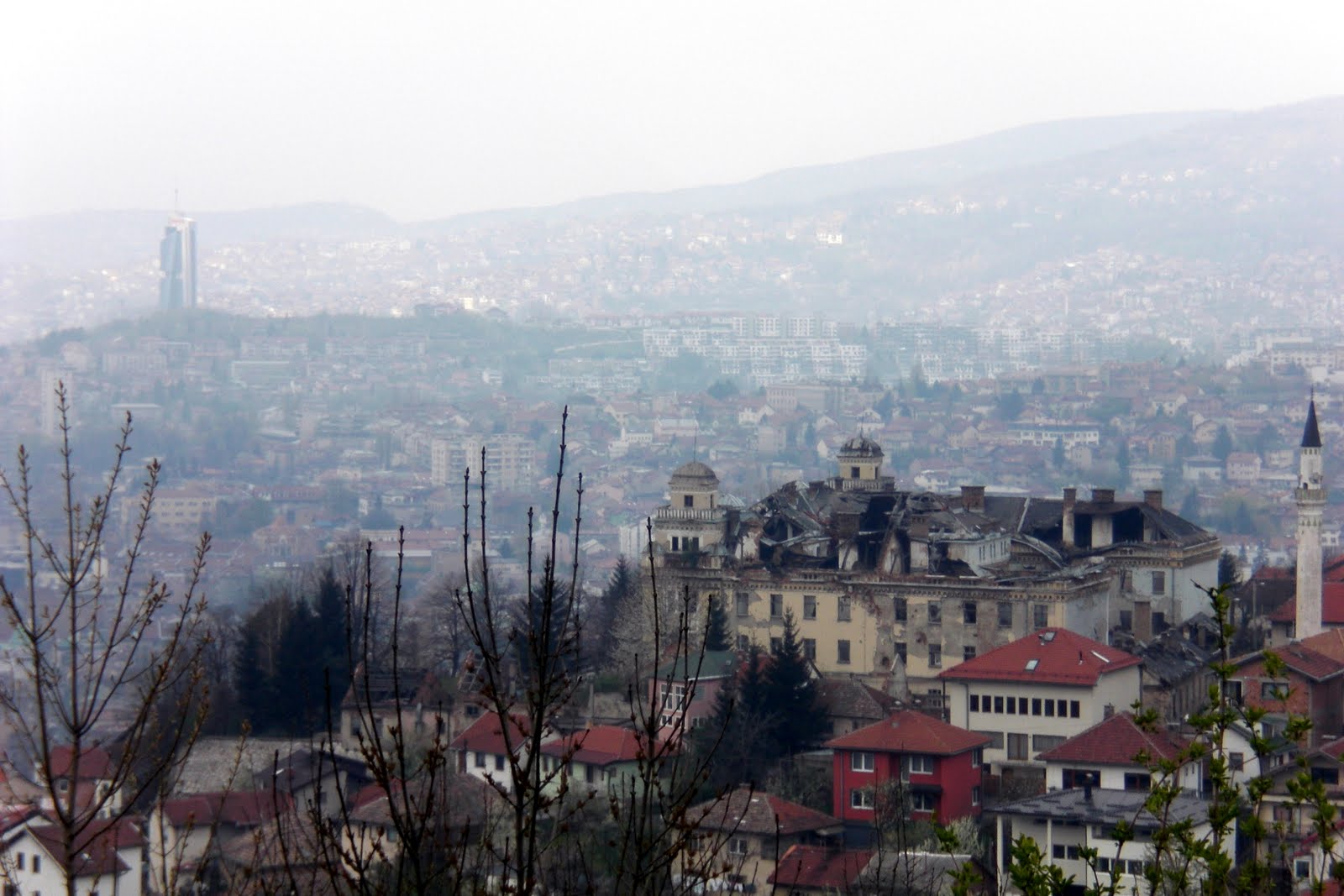
We spent most of our Sarajevo time wandering. The first morning we headed up the hill at the end of town where we found some great views, the city gate, some ruins of a fortress, and a large bombed out building. From that hill we could see in one direction roads pointing through a beautiful mountain pass and in the other direction, the city. The city was in a valley with houses crowding the hill-sides. I could picture Serbian artillery perched on the high ridges above the city. From 1992 to 1995 the city was under siege by Serb forces. Visible signs of the siege can be seen in the large bombed out building at the top of the hill, bullet holes peppering the sides of many of the downtown buildings, the memorial to the children who were killed, and the Sarajevo rose. After lunch our wanderings continued past the souvenir vendors into the crowded walking streets with the occasional terasa where Italian coffee was the drink of choice. We passed both the Catholic and the Serbian Orthodox cathedrals. There was a group of older men playing chess in the park just in front of the Serbian Orthodox church. The chess pieces had to be three feet tall. That evening we returned to the old Ottoman section of town where we entered a bar to get something light to eat and a drink. The owner of the bar insisted that we share a table with some others downstairs rather than stay alone on the second floor. It ended up being a great idea as some local musicians drinking at the end of the room picked up instruments and began playing and singing.

During one of the days we took a two and a half hour morning bus ride to Mostar. Mostar is the largest city in the region of Herzegovina and I had no clue it existed until about two months ago when I asked some fellow volunteers about their trip to Sarajevo. They told me that I had to check out Mostar. The bus ride took us past some mountain villages and into a long beautiful gorge where we followed a turquoise river under rocky walls and jagged peaks. It was significantly warmer in Mostar than in Sarajevo. The sun was shining as we strolled over old stone streets through a courtyard of a mosque and a bazaar. Finally the view opened up to show the famous bridge (stari most) in the center of the old city. It was a stunning sight connecting two rock fortresses hanging high above the fast flowing water of the Neretva River. In a couple of locations I found stones with the phrase "Don't Forget" painted on them referring to the 1993 destruction of the bridge by the Croatian Defense Counsel. I wonder why I only saw it painted in English and not say... Croatian, Bosnian, or Serbian. After some Cevapi for lunch we went down to the water where we found a rock to relax on, dip our feet in, and admire the bridge from below. After more roaming, a drink, and watching a man jump from the high bridge we made our way back to the bus station to conclude our day trip to Mostar.

The final evening in Sarajevo was my favorite. After a traditional coffee we grabbed a couple beers at a supermarket and headed up the hill to check out the sunset. Though it was quite chilly, the city looked really nice as night fell down over the minarets, church steeples, and skyscrapers in the distance. After descending back into town we entered a hookah bar where we sat and chatted with some Bosnians and Turks for the last couple of hours before concluding our final evening in Sarajevo.


Back to Belgrade we went, another day lost to a 10 hour train ride. Such a train ride isn't so bad with good company and a good book handy. I had started a book about environmental conservation given to me by a fellow volunteer. That evening in Belgrade we hung out at the hostel again. The first time through we had stayed there in the common room chatting with three Americans, a few Slovenians, and an Israeli. We were surprised to see that the Israeli was still there when we came back through. I stayed up late into the night with him and the hostel night guy discussing the region and its history.

The final day of our Balkan excursion was dedicated to getting back to Romania. We made a last day decision to try hitching back. Admittedly the highway ramp hitching point was a bit sketchy but with a destination sign and a few pointers from locals we picked up our first ride for about 12kms. The man was very kind. He attempted to communicate with us showing us a map with where we needed to go, and dropping us off at the right spot without accepting any money. From there we found a Romanian driver to the border, walked across the border, and caught another Romanian driver to Timisoara. It was kind of an adventure getting back but I am happy that we decided to come back by car if just to have a break from train travel.

This latest trip has helped peak my interest in the countries that once made up Yugoslavia. Last time leaving Serbia I vowed never to return and this time I left discussing the next trip to the region. Maybe next time we'll make it to Montenegro, Kosovo, or Croatia.

Sunday, January 3, 2010

Happy New Year Serbia!

The New Years Eve celebration this year was an interesting one. I will briefly explain the excursion from my point of view. Later on, an official account will be released, one that attempts to compile all 5 versions of the 3 days in Belgrade, Serbia.
That's right, we decided to go to Belgrade, Serbia to welcome 2010. That is the same Belgrade that was bombed by the United States and NATO a little over a decade ago. Though there were a few Serbians that, when they found out we were Americans, couldn't help but mention the bombing, there were also very many Serbians that we met who were extremely friendly to us.

I would say that the trip officially began early in the morning of the 30th when all 5 brave volunteers came together in the "cold man bar." By the time that the last of the 5 showed up, the others had moved into the warm room and were playing the card game dubbed "Cizme" because the original name of the game, "Claim" was too hard to remember. After a short 5am run-in with a deliquent adolescent and a prostitute the group decided to move to the tracks to wait for their train. The train was on time but one of the 5 felt the need to rush to the wagon. In his hurry the volunteer stepped in one of the many potholes that pepper the common Romanian train-station asphalt spraining his ankle. This was the first casualty of the trip and it would haunt the volunteer the following day during his 3 hour repetitive hike around New Belgrade.
The Timisoara-Belgrade train ride was rather uneventful comprising of some naptime and some angry Serbian customs officials at the border. After getting off the train the 5 went on a search for the "too good to be true" hostel that they had previously booked for the busy New Year weekend. After 3 hours of walking, a creepy Serbian asking them to stay in his apartment, one bus stop, and a couple wine breaks, they learned that the hostel was in fact "too good to be true." At that point they went where any PC volunteer would go for a place to stay, the 5-star Continental Hotel.
Now that the group had a roof over their heads they all laid down and took a nice long nap. Later on that night they ate at a very nice, but not overly priced Italian restaurant where all but one ordered a 4 cheese pasta. After dinner they played some cards and got some much needed rest for the New Years Eve events the following day.
The day of New Years Eve was a busy one for the group. It was their day to see as much of Belgrade that they could before preparing for the night's events. Much time was spent at the large citadel that overlooked both the Sava and the Danube rivers. At the citadel the guys got their gun fix, climbing over the old tanks and anti-aircraft cannons that were on display. Next the group headed toward the center of town passing through the Bohemian district, eating a quick lunch, and getting rained on. They stopped at an impressively large McDonalds to get a coffee and wait out the rain. As darkness fell, the group passed by St. Sava's Cathedral and found the Tesla museum to complete their walk through Belgrade. A 400 dinar cab ride followed so they could quickly get back to the hotel and start preparing for the nights events.
Fastforward through preparation.
The group was back in the center of town in their finest dress and well on their way to a semi-blurry New Year's Eve celebration. Unfortunately they were separated because they had to take separate cabs. Luckily one of the girls set out in a search for the others to reunite the group, she succeeded. After getting a couple of drinks the group worked their way closer to the stage were they found a premium pocket of spectators to ring in the new year with. They watched a wicked cool concert in a language that they didn't understand surrounded by American loving university students who were gladly sharing their rum and rakia with their new American friends. The PCRo volunteers did their own special Romanian New Year countdown followed by a "La Multi Ani," and another countdown an hour later with the rest of the crowd. The second countdown celebrated the Serbian New Year and was followed by an impressive fireworks display. A small series of events following the Serbian New Year separated the group. In the hours that followed one couple went to a pizza place where they were presented with free scotch, free pizza, and a couple free slaps to the face. The other couple refused to get screwed over by a cab driver and one of them paid with a punch in the face. They eventually all rejoined at the hotel to chat a little and pass out after a long night. All but one. The missing one arrived with perfect timing early the next morning after an even longer night with some Serbian friends that he made.
On the first day of 2010 the group slowly packed up and checked out of the Continental. The nearby mall was closed so they made their way to the train-station and prepared themselves to leave Belgrade. Unfortunately for them their departure was much further away than planned. Their train left the station an hour and a half late and slowly crawled toward Romania. Three hours after the scheduled departure Belgrade was still visible. At one point the group spotted smoke billowing out of the engine of the train and in a bit of a panic slipped their shoes on expecting to soon be evacuated. Eventually the smoke stopped and the next problem was a group of rowdy drunk Serbians harassing them. One of the 5 volunteers referred to their group as "monkeys in a cage." Despite the annoyances the volunteers were in good spirits, passing the spiked cola bottle and laughing about their adventures. Finally the border was reached and a sigh of relief came over the group. "We've finally made it home," one of the 5 uttered. At least one of the newer volunteers thought of Romania as their "home" for the first time after arriving less than a year earlier.

New Year's Eve 2010 was certainly a memorable one. I can now add Serbia to my short list of countries that I've visited. With all that happened, a sprained ankle, punches in the face, getting poured on, fake hostel, the spirits remained high throughout the adventure and upon arrival in Romania the group consensus was that we had a great time.