Wednesday, April 27, 2011

Walkin' in the Balkans

With some annual leave days left and the end of service nearing, an out-of-country excursion made perfect sense for the long Easter week off this year. Romania is the place to be for Easter celebrations so we had to be back in country by Holy Thursday. A six-day leave was in session starting on Friday with our early morning train departing from Timisoara into Serbia and ending with a leisurely walk across the border back into Romania the following Thursday.

Yes, I know that after my last venture into Serbia I swore never to return. I lied. Since the last trip there for NYE 2009 my curiosity in the region has been growing. My wonderful experiences in Turkey have helped to peak my interest in Sarajevo, another city where east meets west. Serbia was the necessary stopping point on the way to and from Sarajevo, and under much more ideal conditions my visit to the country that US and NATO planes bombed in the semi-recent past ended up shedding a positive light on the country. Successfully finding our hostel is just one of a few more positive conditions this time around.

Less than ideal was the transportation situation. Train connections left my travel buddy and me sitting in a gas station for hours missing some much needed sleep before even leaving Romania. If one was to look at the distance from Belgrade to Sarajevo on a map they would certainly not say that it takes 10 hours to get from one to the other by train. Unfortunately that is what the man selling the tickets says as you're handing over your money. At least it didn't cost much. Though a collective 20 hours of daylight lost in transportation leaves a sour taste in the mouth of just about any traveler, it didn't seem all that bad. The compartments were surprisingly spacious and the train was not at all crowded leaving us time and space to catch up on sleep and admire the passing countryside. There really wasn't all that much to see until we entered Bosnia-Herzegovina where hills began to rise up giving us a slightly more entertaining country-side to look at and exposing some small villages to our view. I noticed that the country houses in Bosnia were much larger than those in Romania but they didn't appear to be entirely finished. They were surely livable but the bricks and cement in-between were left uncovered. The poverty visible from the train while leaving Belgrade was unseen as we pulled into Sarajevo, though the destruction caused by the war was already visible.

Sarajevo is a small European capital made famous by the assassination of Archduke Franz Ferdinand which helped to kick off the First World War. My original draw to the Bosnia-Herzegovina capital actually came after visiting Turkey. While talking up Istanbul I remember somebody mentioning that I can get a bit of that Ottoman feel in another European city where it mixes in with some other cultural elements. Originally built by the Ottomans, the oldest part of the city has that bazaar feel with the occasional Mosque. Moving west through the town's center you quickly find yourself surrounded by the architectural influences of the Austro-Hungarian Empire. Finally as you continue on into newer parts of town you see the communist influences in the architecture. Though the city appears to be predominately Muslim the old center holds both Catholic and Serbian Orthodox cathedrals along with several smaller mosques and a large synagogue. Our apartment was about half a kilometer up the hill from the Latin Bridge, the sight were the Archduke was shot.

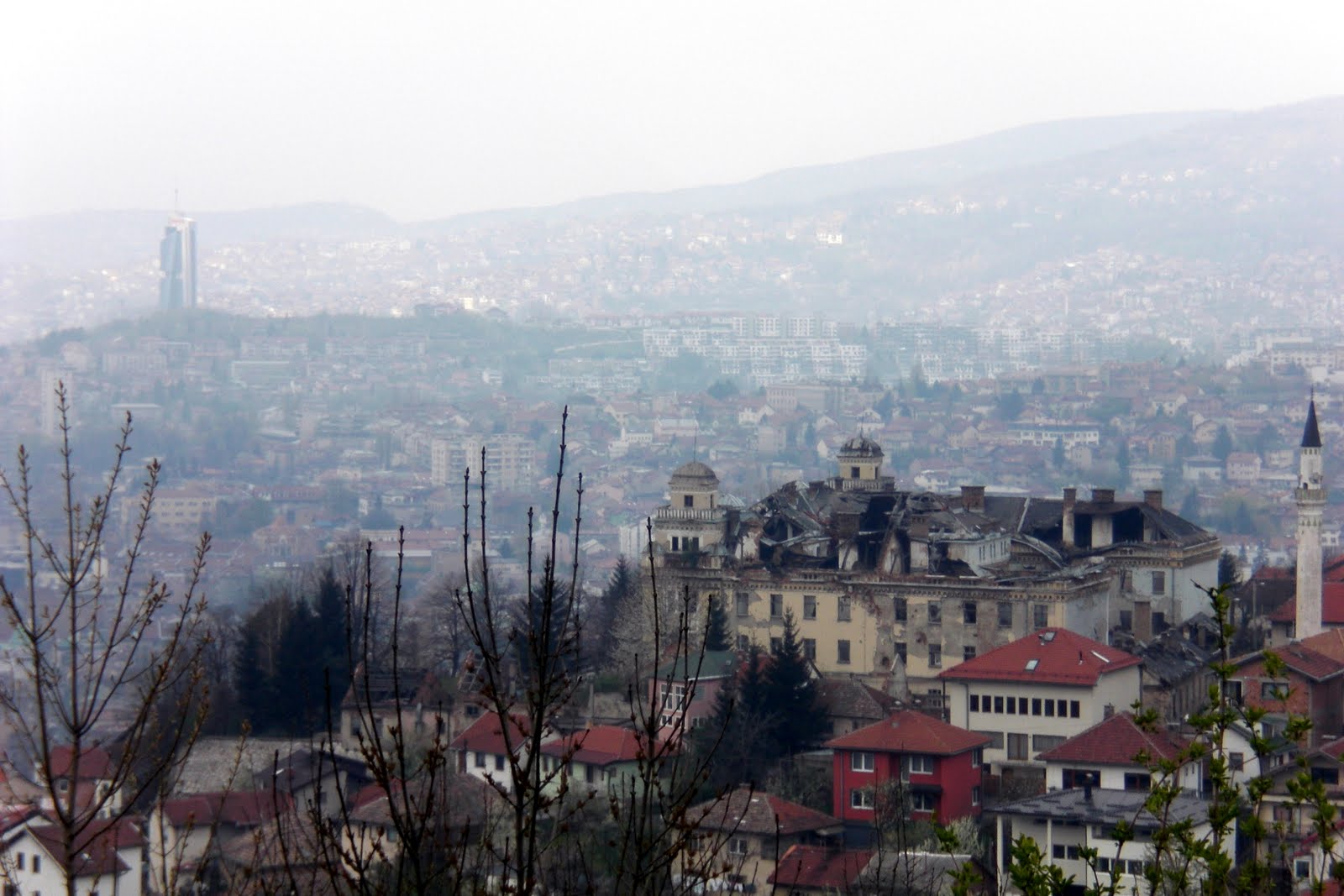
We spent most of our Sarajevo time wandering. The first morning we headed up the hill at the end of town where we found some great views, the city gate, some ruins of a fortress, and a large bombed out building. From that hill we could see in one direction roads pointing through a beautiful mountain pass and in the other direction, the city. The city was in a valley with houses crowding the hill-sides. I could picture Serbian artillery perched on the high ridges above the city. From 1992 to 1995 the city was under siege by Serb forces. Visible signs of the siege can be seen in the large bombed out building at the top of the hill, bullet holes peppering the sides of many of the downtown buildings, the memorial to the children who were killed, and the Sarajevo rose. After lunch our wanderings continued past the souvenir vendors into the crowded walking streets with the occasional terasa where Italian coffee was the drink of choice. We passed both the Catholic and the Serbian Orthodox cathedrals. There was a group of older men playing chess in the park just in front of the Serbian Orthodox church. The chess pieces had to be three feet tall. That evening we returned to the old Ottoman section of town where we entered a bar to get something light to eat and a drink. The owner of the bar insisted that we share a table with some others downstairs rather than stay alone on the second floor. It ended up being a great idea as some local musicians drinking at the end of the room picked up instruments and began playing and singing.

During one of the days we took a two and a half hour morning bus ride to Mostar. Mostar is the largest city in the region of Herzegovina and I had no clue it existed until about two months ago when I asked some fellow volunteers about their trip to Sarajevo. They told me that I had to check out Mostar. The bus ride took us past some mountain villages and into a long beautiful gorge where we followed a turquoise river under rocky walls and jagged peaks. It was significantly warmer in Mostar than in Sarajevo. The sun was shining as we strolled over old stone streets through a courtyard of a mosque and a bazaar. Finally the view opened up to show the famous bridge (stari most) in the center of the old city. It was a stunning sight connecting two rock fortresses hanging high above the fast flowing water of the Neretva River. In a couple of locations I found stones with the phrase "Don't Forget" painted on them referring to the 1993 destruction of the bridge by the Croatian Defense Counsel. I wonder why I only saw it painted in English and not say... Croatian, Bosnian, or Serbian. After some Cevapi for lunch we went down to the water where we found a rock to relax on, dip our feet in, and admire the bridge from below. After more roaming, a drink, and watching a man jump from the high bridge we made our way back to the bus station to conclude our day trip to Mostar.

The final evening in Sarajevo was my favorite. After a traditional coffee we grabbed a couple beers at a supermarket and headed up the hill to check out the sunset. Though it was quite chilly, the city looked really nice as night fell down over the minarets, church steeples, and skyscrapers in the distance. After descending back into town we entered a hookah bar where we sat and chatted with some Bosnians and Turks for the last couple of hours before concluding our final evening in Sarajevo.


Back to Belgrade we went, another day lost to a 10 hour train ride. Such a train ride isn't so bad with good company and a good book handy. I had started a book about environmental conservation given to me by a fellow volunteer. That evening in Belgrade we hung out at the hostel again. The first time through we had stayed there in the common room chatting with three Americans, a few Slovenians, and an Israeli. We were surprised to see that the Israeli was still there when we came back through. I stayed up late into the night with him and the hostel night guy discussing the region and its history.

The final day of our Balkan excursion was dedicated to getting back to Romania. We made a last day decision to try hitching back. Admittedly the highway ramp hitching point was a bit sketchy but with a destination sign and a few pointers from locals we picked up our first ride for about 12kms. The man was very kind. He attempted to communicate with us showing us a map with where we needed to go, and dropping us off at the right spot without accepting any money. From there we found a Romanian driver to the border, walked across the border, and caught another Romanian driver to Timisoara. It was kind of an adventure getting back but I am happy that we decided to come back by car if just to have a break from train travel.

This latest trip has helped peak my interest in the countries that once made up Yugoslavia. Last time leaving Serbia I vowed never to return and this time I left discussing the next trip to the region. Maybe next time we'll make it to Montenegro, Kosovo, or Croatia.

Monday, April 11, 2011

Remembering the Great Finger Lakes region of New York State

It has been almost 23 months since I left New York state bound for Romania. They say that you don't know what you have until it's gone. That idea brings back memories of sitting around the skate park, the lunch table, or the classroom during my high school years. "First chance I get, I'm out of here," so many of my friends would say. "What does Corning have to offer me? Its too small. Everybody knows your business. There's nothing to do here." There arguments were pretty convincing. Their dreams of bigger and better places would get to me at times, especially on those rainy days that we saw so much of in upstate. For me it didn't take leaving to realize what I had, just a bit of growing up. By the time I left for California in the fall of 2008, my first real move out of the region, I was fully aware of all the great things that my part of the world had to offer.

It was during the college years that I got out and learned to love the great Finger Lakes region of New York. In the summers I held various jobs. My last two summers in town were spent working in museums where I had the chance to speak with outsiders and promote the beauties of my small little town. Friends and I would eagerly await the weekend when we would go to some of the great bars on market street or take evening bike rides. Some of the best times were when we had a common day off to trip it to Ithaca where we would discover one of the state parks, sit by the lake, or walk slowly through the commons. I can't give enough credit to the grad student at Cortland that offered me my first backpacking trip to the Adirondacks nearby. My finger lakes places were Ithaca, Cortland, Watkins Glen, and Keuka College where I visited Colin on a number of occasions.

During my time in Romania memories of those beautiful state parks have come frequently to put a smile on my face. I live in a part of Romania that has much of its own natural beauty. When I moved in with my host in Targoviste I was prepared with a picture book of the Finger Lakes region to give to them as a gift. As my parents were putting together a box of things to send me and they mentioned giving something to Ernest, that Finger Lakes picture book was the first thing that popped into my head. He loves being in nature and taking pictures of nature. "Rain or shine it's a sin to stay in the house all day," claims Ernest from time to time. As the region I live in now sits at a higher elevation than the one I left in New York, my outdoor adventures typically yield different views and a different feel. This past weekend Ernest took me on a new hike. (After a year and a half of going on hikes whenever I get the chance, there are still new trails to discover here.) This latest hike reminded me most of those gorge trails that I saw so much of in my college years.

It started out like a lot of other hikes that we've done. Really the first half of the hike I've probably done 8 or 9 times. There was a bus to Lupeni, a quick spin through the piata (market) and a 3-4 hours of walking up hill to Straja. The hike up actually follows stations of the cross. The first station is right outside of Lupeni and the final one is at the small church up at the ski area. With a number of switch-backs along the way we would periodically enter in the woods to take a shortcut. Along the way we stopped at a spring that was covered in leaves from the previous fall. I brushed the knee-high pile of leaves out of the way to fill up my bottle. Like every other trip to Straja we entered the first cabana on the right where we sat, rested, and chatted over a drink. Up until that strawberry banana juice things had seemed just like they always had, aside from the strong wind gusts. This area of Romania is pretty well protected by the mountains and therefore we do not get a whole lot of wind. During this particular hike the wind was the strongest that I have seen it in the Jiu Vally.

After our drinks the adventure began for me. We entered the forest on a new trail, going in a new direction, and I was excited to see some new things. It wasn't long before I noticed that that particular trail was quite steep. Not many people know about that trail which it is evident, as it was not always easy to find our way even though it was marked quite well. It took about 45 minutes to get to our lunch spot. Just before the lunch area we climbed down a steep part of the trail where I was forced to use both arms and legs to ensure my stability. Those are the parts of the trail that I like the most. The lunch spot was marked by a wooden table and bench that, despite their weight, had both been blown over due to the strong wind gusts that day. We sat there bundled up, our plastic bags weighed down, eating our slanina, onion, and bread as the wind beat against our backs.

The couple of hours of hiking after lunch led us through the forest and back to Lupeni as we came out near the chair lift. During those couple of hours I was reminded of the Finger Lakes region more than I have been yet in Romania. There were no large lakes nearby but the trail ran along a steep slope parallel to the stream below. The steep rocky slopes running along-side the stream with its waters cutting through rocks and tumbling down into open pools all reminded me of the gorge trails of Rock stream, Truman, and Buttermilk. After our lunch break the trail continued down a steep slope and across a small bridge over a stream. A little further down the trail we stopped and looked back to view a waterfall. Looking back upstream there were two more waterfalls in the distance that we had already passed without realizing. Following that stream a little further we came upon a larger stream with an even larger waterfall standing at about five meters in height. The next resting stop was about 45 minutes of slow hiking away. The red point trail followed the stream but we were forced to move at a slow pace due to the leaf coverage on the trail. There were parts where the leaves were several feet deep with rocks and branches hidden underneath. Eventually we arrived at a spot where the red point trail turned uphill circling back to Straja.

After a short break of eating delicious kiwis we continued on as the trail followed along-side the stream high up on the slope. We climbed over rocks, under branches, along steep slopes and finally we passed through a tunnel to the finish. Periodically we looked back to see the stream with its pools and waterfalls each time taking me back to the great Finger Lakes region of New York State.


Monday, March 28, 2011

Close of Overseas Service

Wow, COS has finally arrived.

Learning about all of the different PC events that we would have to attend in our service, COS was always so far off in the distance. Even after our last event, MST (mid-service training) COS still seemed a long many months away. As I write, all of the conferences have come and gone. From now until the end of my service I am a single volunteer. Even though everybody's Peace Corps service is largely an individual or community accomplishment, for me the group mentality has always been at least a bit present until late Saturday afternoon. By group, I am referring to my swear-in group, group 26.

Unlike at other Peace Corps posts, PCRo volunteers conduct all of their required PC training events as a whole group. We staged together, trained in Targoviste together, swore-in together, and we just conducted our last in-service training event together, the COS conference. Immediately after leaving PST and each of the in-service training events, I have on every occasion felt a strong bit of loneliness. After spending at least a couple of days with a large group of people that I call friends, I am once again alone on a train reflecting upon those days. I have learned that such a feeling will only last a day or two maximum, but at the time, sitting on that train and looking out into night, the feeling's strength is at it's peak. This last conference was a bit different in that some final goodbyes had to be spoken. We will not meet again as group 26.

On a lighter note, the COS conference signifies the fast approaching completion to our Peace Corps service. When someone signs up for the Peace Corps they know that it won't be easy and that they have the option to back out at any point in the process. Many people do decide to go home early and they always have good reason to do so, but looking at fellow group members at the COS conference I couldn't help but say to some of my closest friends "wow, we made it". If you've graduated college or highschool then you know about the bittersweet feeling that I felt as I said some goodbye's to fellow 26ers. I'm sure that that feeling will resurface as I prepare to leave my site.

The conference was a very busy event held at a nice 4 star hotel in Sinaia. Sinaia is one of the most well known tourist towns in Romania. It is a small town in Prahova Valley at the base of the eastern edge of the Bucegi Mountains. The Prahova Valley is one of the most beautiful mountain regions of Romania and by far the most visited as it is the closest to the nations capital. Sinaia offers good skiing, hiking, and great views from it's gondola. It is also home to the Sinaia Monastery and Peles Castel, residence of King Carol the first. Highlights of the conference include but are not limited to: PC service timeline, cutting Ted's hair, interviews, discovering beautiful Sinaia, birthdays in the lobby, Manuela and Ben painting, Chels's poem and superlatives at the COS dinner party. Of course there were also some really informative sessions put on by staff to help prepare us for the next few months of ending our service in Romania the coming months of readjustment back in the states.


View from my hotel room


Ben showing off his painting skills


Group 26 and PCRo staff shaking it at the COS party!


Peles Castel

Tuesday, March 15, 2011

Peace Corps Invades Cluj

With the insider help of veteran volunteer Doug, Peace Corps Romania descended on Cluj in full force on the weekend of 12 March 2011. The American forces started to move in on the western Romanian city on the evening of the 11th. That evening PCRo's rookie committee, the Multicultural Awareness Committee(MAC) held their inaugural meeting bringing together volunteers from both groups 26 and 27 to discuss the committee's mission and future involvement in the upcoming PST. Meanwhile volunteers were filing in from all parts of Romania to attend the following days' events. Those events included the spring GAD and VAC meetings on Saturday, and Sunday's annual Warden training.

Arriving by train late on the evening of the 11th, I attempted to find my way to the hotel in the city center on foot. I had been through Cluj before but only in transit. On a couple of occasions Cluj has acted as a stopping point for me connecting one leg of a trip to another. My last encounter with the Transylvanian capital was a four hour stop between a return flight from Venice and my train back to site. During that four hours I wandered through the city center snapping photos, drinking coffee, and reading my book next to the city's impressive St. Michael's Cathedral. I arrived in the city center cutting down taxi costs but eventually had to find a ride to the hotel that I was not familiar with. Still feeling ill from a cold that I caught earlier that week I decided to stay in and rest up for Saturday's meeting.

After a nice breakfast at the hotel and some miner last-minute preparations for the meeting the group of PCRo staff and volunteers made their way to Cosul Verde, a small organic food shop with a coffee shop upstairs which would be the VAC meeting room for the day. With increased participation due to other meetings that same weekend, Cosul Verde was the perfect location, just large enough to comfortably fit all participants. In classic VAC meeting style the scheduled 6 hour meeting lasted 7. The morning cruised by on schedule with a large variety of agenda topics leading straight into lunch at 1:00 on the dot. Two of the staff members present were experiencing their first VAC meeting in Romania. One was the PTO who recently came on board in November and the other was the Peace Corps Security Officer for the region stationed in Albania. Their presence added great value to the discussions as well as important information on the direction of PCRo and PC worldwide. An added bonus to the group of participants was veteran PCVL Chris. The Lunch Box was the perfect spot to get all of the VAC, MAC, and GAD members sufficiently fed and rested for the joint afternoon hour to come.

While VAC and GAD held their meetings at the same time but in different locations, GAD and MAC representatives were able to join the VAC meeting in the afternoon to present their committee updates. After the joint committee hour GAD reps returned to their meeting location and VAC continued on with survey presentations. This part of the agenda took longer than expected as the results of both the VAC annual survey and the group 27 site integration survey came under heavy, but necessary discussion. Finally the end of the meeting came one hour past its scheduled timing.


The beautiful spring day allowed me some time after the meeting to snap some pictures of the large statue outside of the cathedral. The statue is of Matia Corvin a former king of Hungary. Though I had visited Cluj on previous occasions this was my first sighting of the statue as it had been under construction during my earlier visits.

The evening began with a satisfying dinner at 360 where I ordered a plate of delicious fries, a cheeseburger and some cole slaw. It was the most American meal I had had since my cheeseburger meal at the small Irish pub, McGowen's, a year earlier in Medias. From there we wandered through the old Romanian-Hungarian streets hopping full bars until finally arriving at an artistic 2nd floor joint called insomnia. It was an interesting bar with several rooms that get redecorated every six months. It was there where we chatted over Stejars until heading back to the hotel.

Luckily the next day's warden training was pushed back from 9am to 10:30 allowing us all some time to rest a bit more and eat a nice breakfast before getting starting. For many, the warden training was a refresher in case there is an emergency in Romania. As for myself, I was receiving the information for the first time since I have only recently become a warden. Basically a warden simply relays information between staff and volunteers, and keeps things under control if there is an emergency in the country. The training didn't last too long but it was thorough and helpful. It was also the last meeting, closing out the weekend in Cluj.

Even though the last meeting had ended, my Cluj time continued. My next best travel option was at 9:30 the following morning. That evening after the warden training I wandered around with my colleague Cbrown and we found the less-than-impressive cock church. Instead of a cross at the top it has a rooster. Next we ate some really good Indian food where I said goodbye to her and a couple of other colleagues venturing south to Turda. A bit later on that evening, wandering through the downtown walking streets with Chris and Ted, we heard some music that would turn out to be a major highlight of our Cluj trip. In a second-floor bar we found a young group of musicians playing some great sounding jazz music. Sitting there in the corner with our Silva's we admired the music and introduced applause to the room after each song. The band was made up of a keyboardist, bass player, drummer, and a violinist, student musicians jamming out with each tune they played. We stayed there until the band finished and even found one other bar to have our last drink of the night. It was a proper ending to the weekend of PC meetings in Cluj.

Friday, March 4, 2011

Mărţişor


Being an English teacher in a foreign country you get to celebrate a lot of holidays. Of course you get to celebrate or at least recognize the host country holidays, but you are also charged with the responsibility of appropriately representing your own holidays and how they are celebrated. Here in Romania, English teachers are well into the spring holiday run even though spring hasn't really come yet. This run seems to start with St. Valentines Day which is followed by its Romanian counterpart ten days later, Dragobete. Fast-forward just five days and it's Martisor already which is followed by 8 Martie, or Mothers Day, one week later. The first week of March begins and ends with a celebration focused on women so I simply consider it woman's week. During that week I am more consciously polite to any women that I may encounter. Finally, ten days after 8 martie we arrive at one of my personal favorites, St Patty's Day. At the moment we are in the midst of woman's week so I'd like to say a few words about my favorite Romanian holiday, Mărţişor.

Mărţişor is a celebration of the beginning of spring. The first flower that brings in the season is the snow drop and it is given as a small gift on the first of March. Leading up to Martisor you begin to see stands pop up throughout town offering small gifts. The basic, cheap, Martisor gift is a small ornament in a box with a red and white string tied to it. This ornament can be pinned to ones shirt. There are also more complex Martisor gifts ranging from bouquets of flowers to various display ornaments. Whatever the gift is, cheap or more elaborate, it is always well appreciated. Martisor gifts are always given to women. Sorry guys. Many students will bring them to their women teachers, or male colleagues will give them to their women colleagues. Martisor technically means "little March" or "Dear March".


Last year, when I first saw Martisoare, they actually did seem to signify spring. I remember it being a nice spring day when I was looking through the piles of brightly colored ornaments, picking out some for my colleagues. The snow drops were a welcomed sight and I remember that I started seeing Crocuses on the Parang footpath only a week or two later. After the Crocuses came the Narcissus, my favorite springtime flower. Spring evolved and became, by far, my favorite time of the year here in the Jiu Valley. This year has already turned out to be a bit different. It was a colder, longer winter already and an end is not yet in sight. I can't complain too much as this type of weather is expected here and still, in the cold, I manage to have some pretty great outdoor adventures. Last year we were lucky to have an easy, mild, short-lived winter. Either way, I am eagerly waiting spring. During this year's Martisor I spent a little less time scanning the tables of gifts. There was a warm fruit tea calling my name nearby.

Thursday, March 3, 2011

March 1st

Once again Peace Corps's birthday is the subject of the post. Fifty years ago on March 1st, Executive order 10924 established Peace Corps, though it was not authorized by congress until September. To commemorate Peace Corps's official 50th anniversary Peace Corps Romania held informational sessions promoting volunteerism at every "American Corner" around Romania. I was fortunate to be able to be a part of this project.

Italic
An "American Corner" is a section of a library that offers books in English and reference books on the United States of America. It may also include films and recordings from the United States. American Corners support local English instruction offering a variety of language learning materials. It may also include informational sessions about the United States or given by a citizen of the US. There are currently 8 American Corners in Romania. American corners exist in libraries all over the world.

My colleague Chelsea and I were assigned to give a presentation at the American Corner in Craiova. When I first signed up to help for this project I originally offered to help in either Craiova or Cluj. Cluj is a great city that I have been to a few times in passing but never to stay very long. I have not yet been in Craiova but I pass by it sleeping whenever I take the night train to Bucharest. Since there are not many volunteers near Craiova, and quite a bit of volunteers up by Cluj, I figured that I would end up doing the session in Craiova. Craiova is the largest city in the region of Oltenia. Oltenia is known for it's fast speakers, perfectul simplu tense, and flat landscape, though the northern part of Oltenia is mountainous. I frequently visit Oltenia because it borders my town, but I have not yet had a chance to wonder around Craiova.

Chelsea came up to visit the Sunday before Tuesday's presentation to hang out, plan the presentation, and get a slightly better travel option to Craiova. That travel option happened to be a 4:00am Personel train that got us into Craiova's beautiful train station at about 10:00am. Craiova's gara is the nicest train station that I have passed through in Romania. It is even heated. From there we took a 6 lei taxi to the center of town where the library is located. On the phone the American Corner director emphisized taking a Romnicon taxi. Romnicon is a taxi company in Craiova that appears to be a trustful one.

When taking a taxi in Romania the customer must be attentive, especially if they are foreign. One trick that the driver might pull is the broken meter. They will claim to have a broken meter and then when you reach your destination the driver can charge what he wants. Just looking in to see if there is a meter or not isn't enough. I either ask him to turn the meter on or I ask him roughly how much it will cost to get to my destination before even entering the cab. Negotiating the price before entering the cab works well because then he doesn't have the option of taking you all around the city before finally arriving at your destination.

I was impressed with Romnicon's service. Every time we took a taxi we went with Romnicon and every time it appeared as if we went directly to our destination with the meter running.

At the American Corner we were greeted by friendly staff, a coffee and some great cake that the AC director made for us. We had a bit of time to freshen up after the long train ride and then we were brought in to speak quickly with the library director. The library director seemed concerned about receiving a new volunteer. They had had a great Peace Corps volunteer working there for two years and I could tell that they really loved and appreciated her. They would like another volunteer but unfortunately they can no longer apply for one. Only teachers in nearby schools can receive volunteers now as PCRo has moved to an entirely TEFL post. If a volunteer from the next group ends up in Craiova they have a great contact with the library there that will provide them with dedicated counterparts and a rewarding secondary activity. After meeting the people at the AC I really hope a volunteer ends up there to help them out.

It was almost time for the presentation when Chels and I were called to the back to talk to the media. Speaking Romanian in front of a camera was not an easy task but I hope that the obvious mistakes were edited out before the footage made it to air, if it ever did. I have refused to search and find out if it was ever actually played on air.

The presentation went smoothly. Members of the audience were no strangers to volunteering. When I told them to "stand up if you have ever volunteered" everybody in the room was standing. They were high school students and I was quite impressed. With them we discussed volunteering, told them about Peace Corps, and shared stories about volunteering. Many of them were volunteers for "Salvati Copiii" a volunteer organization that some of my students are involved in. After Chels and I presented a couple of other organizations spoke shortly about what they do and how the young people in the audience can get involved. After the meeting ended Chels and I were surrounded by young volunteers interested in what we do, why we are here, and our impressions about Romania.

The day had only just begun. Madalina, an assistant at the American Corner was charged with the responsibility of showing us around Craiova. We wandered around the center seeing the Museum of Oltenia where we learned about the traditional costumes, beautiful rugs, farming, pottery, and puppets. A delicous lunch split up our museum visits and we wandered through another three story museum about the diverse plan and animal life in Oltenia. We took a long walk through an impressive park where we saw a small zoo and a nice suspension bridge over the park's lake. Finally we stopped in a nice corner restaurant for a tea to warm up after being in the cold for a while.

After meeting the friendly staff and students at the American Corner and taking the nice tour around Craiova, it is easy to understand how a volunteer had a rewarding two year experience there. It was so rewarding that she continued serving in Peace Corps by transferring to Nicaragua to start another two year service.

The trip ended with a three hour train ride back to Petro, sleeping just about the entire way. An appropriate celebration for Peace Corps 50th birthday I'd say.

http://amcorner-craiova.blogspot.com/2011/03/sesiunea-informativa-pe-tema.html

Friday, February 18, 2011

The Illusionist

The music started slowly and the lights went dim to mark the beginning of the show. Just minutes earlier I was ushered in by Dimitrie Leonida's very own illusionist. He has performed on stage many times before whether that stage was a small space in one of the classrooms or in front of hundreds of students at the "Casa de Cultura". Despite his many previous performances, as he brought me in I could sense that he was nervous, soon to be on stage at the theater in front of a large number of screaming children.

The large majority of the crowd came from the elementary schools in town. I couldn't help but try and put myself in the shoes of those children.
"Wow, a magic show! I can't wait! I wonder if he'll disappear. Pick me, Pick me. Did you see that?"

Next I tried to put myself in the shoes of the few high-school students in the crowd.
"That's lame, I totally know how he did that trick. There's nothing magic about this. Ok, I admit that one was pretty cool."

Finally, sitting next to some of my colleagues I imagined what they might be thinking which was similar to what I was thinking at the time.
"He looks nervous. I hope he rehearsed this. I hope he performs well. Wow, that was a nice trick."

It was a nice trick. They were all nice tricks even though a couple of the illusions he gave away if you were keeping a really good eye on them. I'm sure the kids didn't see him give anything away. They were in awe the entire time, especially when one of their classmates was chosen by the illusionist to come up on stage.

The first of two Friday shows turned out to be a success. There were a couple of minor slip ups, so I heard from my colleague who was sitting next to me and who already knew about all of the tricks. I hope that the second show was a complete success with the first acting as a rehearsal. The Primar was planning on attending the second show as well as more students from the high schools. You've got to be flawless while performing in front of a high school crowd. Some of the highlights included turning a dove into a snake, levitating a small girl chosen from the crowd, and splitting his body at the waist.

Friday at the magic show I experienced yet again one of those great rewards of being a teacher. The illusionist is not one of my students but I see him often in the hall and every time he stops me to say hello and ask me how I'm doing. He hangs out outside of the teachers room where he sees and talks to his friends and many of the teachers. In the week leading up to the show he slipped me two tickets and asked me to come. In the day of the show he showed me the sign that had been posted there for 2 weeks to remind me of both the 2:00 option and the 3:20 option. It's great seeing a student excel at something, especially something independent. Though the illusionist has friends helping him with the show he created the event, he is the main act, and he took the initiative himself rather than having a teacher constantly reminding him, or a parent pushing him into a hobby. Everybody has their own skills, hobbies, niches. The illusionist somehow stumbled upon a hobby that he enjoyed so much as to develop it and now he's using it to do good. Not only is he using it to put that look of wonder and amazement on the faces of those little kids sitting near the front, he is also donating a large portion of the proceeds from the show to a local charity. Abracadabra.